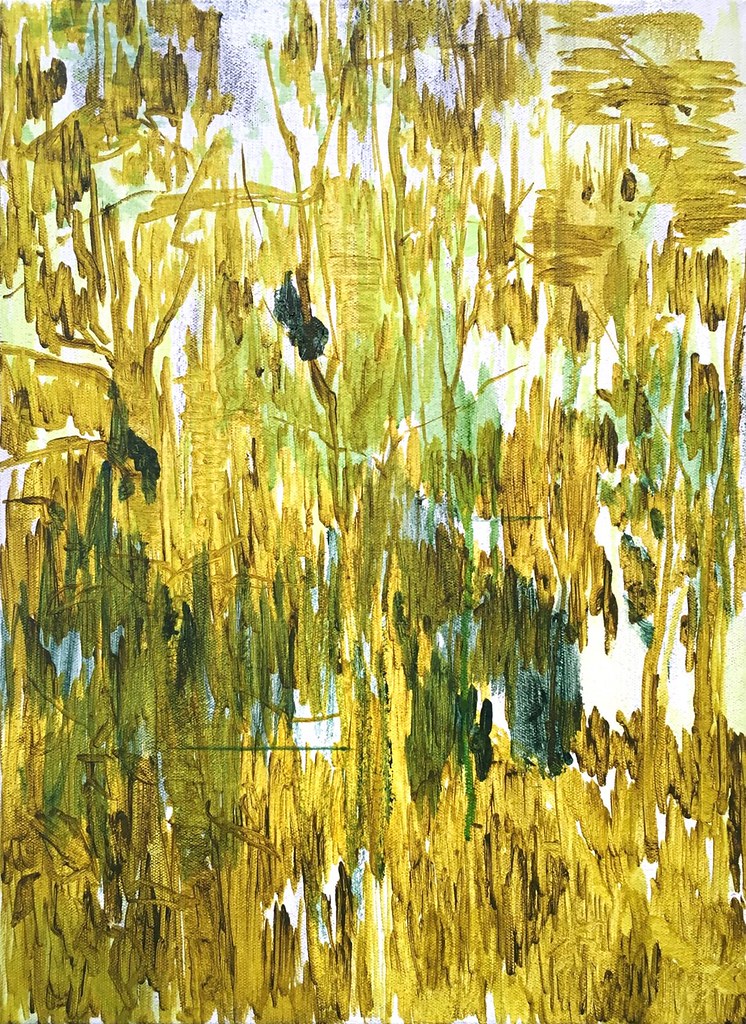
From Sophie Morrish

29.02.2016 - 31.03.2016


Happiness doubled by wonder *  

(Part One)
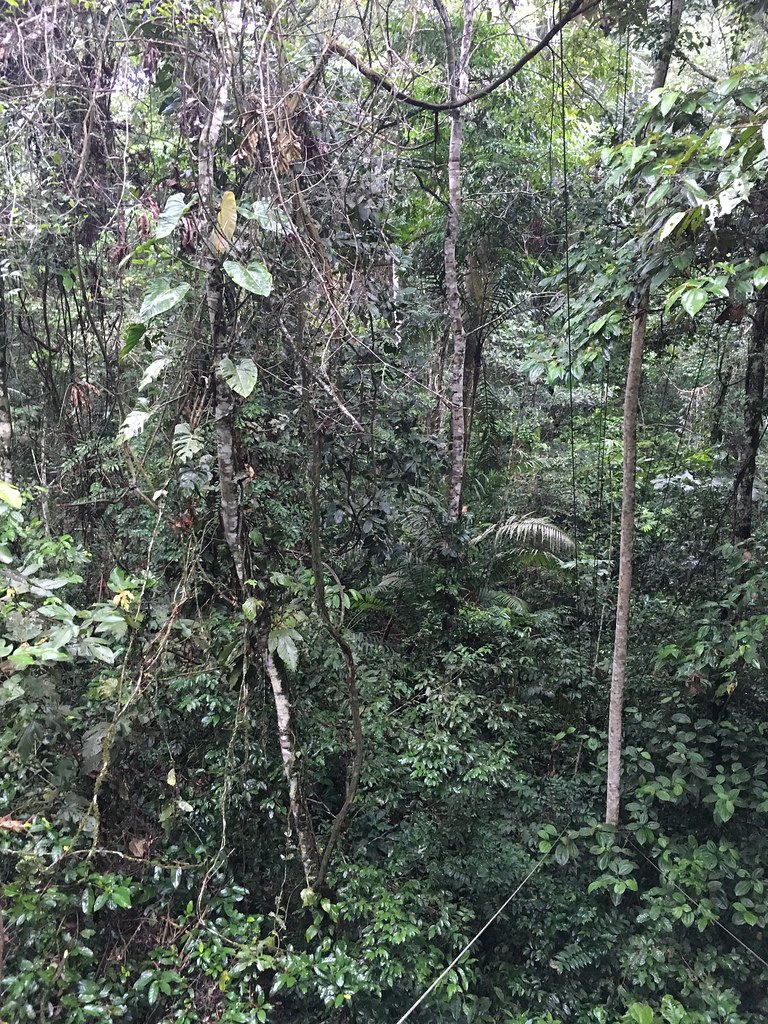
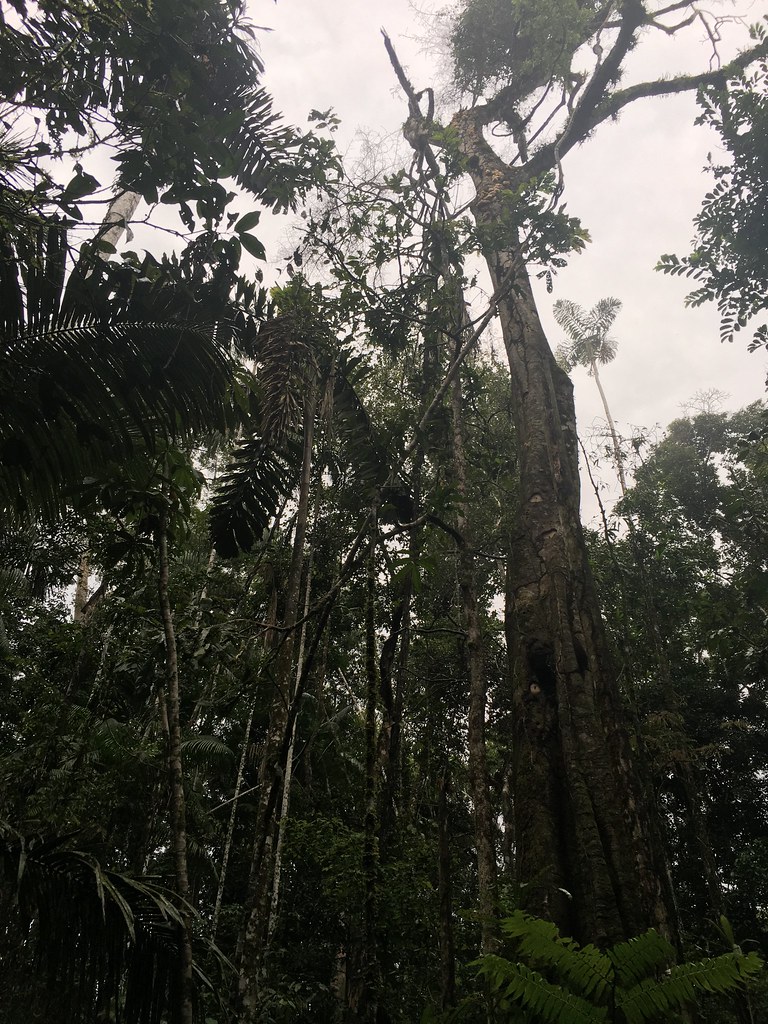
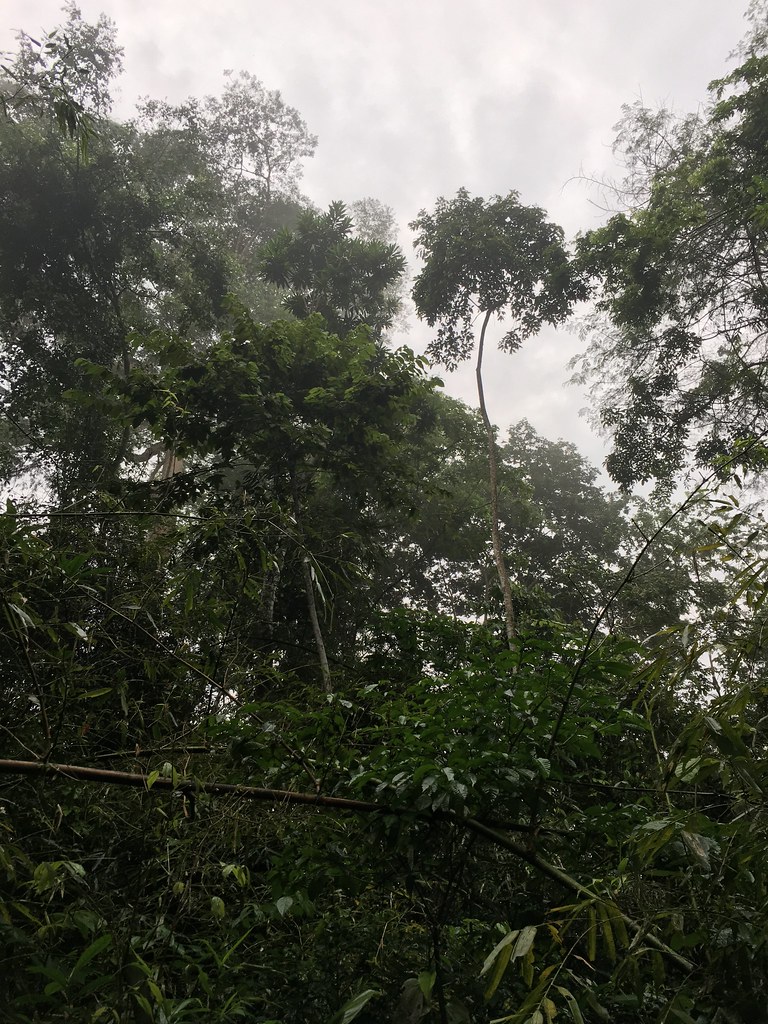
The Tambopata Rain Forest inspired in me a powerful reconnection with a particular state of innocence, one of intense childlike wonder. Overwhelmed by the sensorial clamour of the place, the heat, humidity, sounds and smells, all unfamiliar, all enthralling, not least among them was the sheer visual complexity of the jungle. Looking about you it is difficult to settle your gaze on any one thing, the rich tangle of shrubs, trees and vines, far from being a passive backdrop, is host to a myriad of wonders and innumerable narratives that play out to an intricate soundtrack of birds, insects, monkeys and frogs, mostly unseen, their presence betrayed only by their sounds.


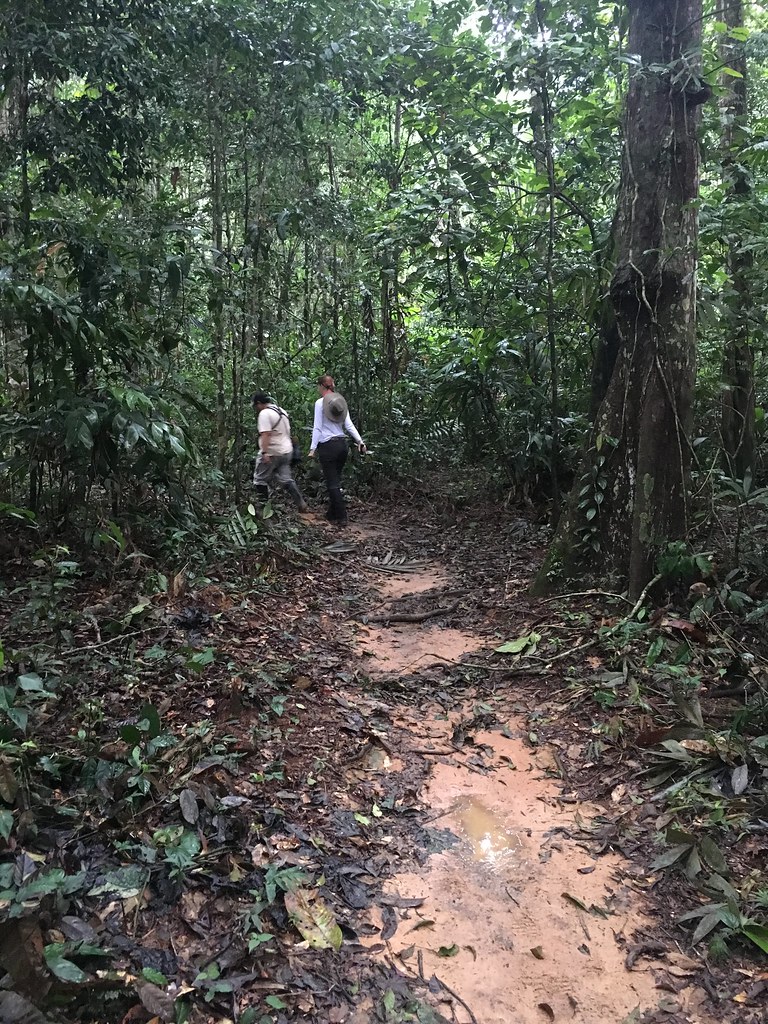
Perception is radically different here to that experienced in a tamed landscape, it is an environment of vital forces, a near pristine habitat of living systems that are evident at every turn, (Tambopata National Reserve is one of the largest contiguous areas of primary rainforest in the Amazon basin and considered by many to be the best). Walking in the forest new and intriguing natural phenomena assail you at every turn; to realise a singular viewpoint or focus is impossible and perhaps more importantly, seems senseless to pursue. Very quickly a strong sense of being ‘within’ takes hold and, surrounded, you realise your perspective is rarely one of any great (physical), distance from a thing observed. 


It takes time to feel your way into this place, as initial fears and uncertainties slowly fall away - although never entirely - they are replaced by transient sensations of ease, familiarity, comfort and most frequently, elation. Days are punctuated in unanticipated ways - the distant sound of a large tree crashing to the forest floor, the chatter of monkeys, call and response between Toucan, the grunting, crunching and snorting of a passing band of White-lipped Peccaries, (not to mention their eye wateringly pungent odour!), the relentless flow of industrious leafcutter ants across the forest floor, all are fascinating, all are utterly absorbing. Once you stop to observe a given phenomena you become aware of all the surrounding relationships that give context to that which first caught your attention. Hours pass in what seem like minutes, the days never long enough to exhaust the feeling of enthrallment. It is the complex living connections, visceral and dramatic that are in essence the magic of the place. Here it is possible to feel deeply, what we, (in the ‘developed world’), have lost by all we have gained. 


Returning home from the jungle, there is so much to process, so many impressions and experiences, thoughts, feelings and ideas. Reading through my notebooks, looking at photographs, films and drawings made, listening to numerous field recordings, it feels too soon…a sharp pang of emotion, a sense of loss even, tells me it is indeed too soon for me to acknowledge this experience as passed, (past). 


My starting point for this residency was to explore unlikely parallels that might be drawn between my ‘habitat’, North Uist, in the Western Isles of Scotland, (arguably one of the most Bio-diverse places in the U.K.), and that of the Amazon Rain Forest, (the most Bio-diverse area of the planet); locations whose natural circumstances could hardly be more different but each of whom is of immeasurable value in their own right and should I feel, be acknowledged and treated as such. This particular strand of enquiry, (a component of other deeply held, long standing creative interests), began with field recordings made in Uist in early 2015. Now, enriched by juxtaposition to the Amazonian ‘data’, the work needs time to develop, I am excited to see where and to what it will lead. I hope I can do justice to all that has brought me thus far.


For an artist whose work primarily stems from walking and consideration of phenomenal relationships, a visit to the Amazon Rain forest was nothing short of the most treasured and exquisite of gifts - one that will enrich and inform my practice far into the future, one for which I do not have the words to adequately express my gratitude for. I am eternally grateful to Nina Rodin and The Trélex Residency for this wonderful opportunity and to Kurt Holle / Rain Forest Expeditions for their unstinting, remarkable generosity in facilitating it. Equal thanks go to all the hardworking staff at the Refugio and Tambopata Research lodges, to the guides and researchers whose knowledge, expertise and good humour added so greatly to the whole experience. Thanks goes too to the many visitors who took a keen interest in my work and who welcomed me to join their walks, in particular Edith Wu, Lynette McLamb & Todd Steiner, with whom, (in the company of Robin their guide), I saw so many marvellous creatures. 


I am grateful also to CNES (Western Isles Council) and Creative Scotland for the Visual Arts Grant that supported my residency and last but by no means least, to my partner René Jansen, for his encouragement and support and for holding the fort and walking the dogs in my absence – I couldn’t have done it without you.

Sophie Morrish
North Uist, April 2016

* I would maintain that thanks are the highest form of thought, and that gratitude is happiness doubled by wonder.

     G.K. Chesterton (1874-1936)


From Ella Dawn McGeough

01.01.2016 - 30.03.2016


and, something like fire dancing: Amy Brener, Patrick Cruz, Barbara Kasten, Scott Lyall  
organized by Ella Dawn McGeough
8 September to 15 October 2016 at Susan Hobbs Gallery, Toronto

Last winter, I spent 87 days on residency in the southwest corner of Peru in the Tambopata National Reserve, an area acclaimed for having the planet’s densest bio-diversity. I brought Public 51 edited by Scott Lyall and Christine Davis on the subject of colour with extensive writing by Isabelle Stengers. While I was preparing to leave Toronto, I was in the early stages of planning this exhibition. With the upcoming limits of communication, I sent preliminary invitations to four artists: Amy Brener, Patrick Cruz, Scott Lyall, and Barbara Kasten. With the exhibition plan barely a sketch, their agreement was a performance of trust.

Initially, what held these artists’ practices together was a question of diffusion: an investment in the stuff of transparency and lightness, whether with the glazed ink and laminated glass within Scott’s works; embedded reflective elements and delicate films of silicon and resin within Amy’s sculptures; temporal quickness at play in Patrick’s unstretched canvases, where individual works act as vectors for the next; or the illuminated planes of screen and glass employed by Barbara in her sculptural sets. Despite the vitreous quality of many of their works, the layers used seemed to offer a resistance against ephemerality. Instead, each artist appeared to assert the relevance of materiality and technique. Through repetition, something light gained substance, like the weight of endurance.

The rainforest is heavy with the weight of its lightest entities: fungi…ants…butterflies. Every rainy season, for a brief duration, a parasitic plant emerges from the bark of a tree as tiny yellow fruit. Caterpillars arrive to relentlessly chew the plant, while a mass of ants stand as bodyguards to protect against would-be predators such as birds and larger insects. The ants are rewarded for their service with honeydew drummed from an exposed organ on the caterpillars’ back. When the butterfly finally presents itself, its wings blaze with an image of the yellow fruit. This image is produced without light; it is an image of home, an image of process called colour. Collectively, each entity survives in sympathy, held to the others through the dynamics of infection.

Likewise, the endurance of a work of art is either confirmed or denied by its power to infect and be infected by other artworks in both the space of exhibition and the space of history. This is not a matter of power as repression, i.e. the power of one entity to impose itself upon a lesser entity. Rather, the term infection is used as a matter of inciting an embodied relationship. What Stengers’ describes as the link between power and adventure. Effectively, the power of one being is gained by its ability to be receptive to the power of another being. The conceit of this exhibition is that―like interspecies relationships evident in nature―that which endures in culture is not self-sufficient. However while in nature, material reality holds subjects together. In visual art, it is subjective reality that holds objects together. It is the visitor’s awareness that forms the non-discursive link between art objects. Held together, each work valorizes the other, shapes the other, attributes a role to the other.

Composed of a relationship between four diverse artists whose respective practices are separated by cultural context, methodology, and media, the exhibition becomes a type of portrayal with the artworks loosely mirroring the role of plant, ant, caterpillar, or butterfly. However, it is a portrait that follows the rules of mimicry over representation. On the wall, Barbara’s work assumes the twinned roles of host and guest, both here and there. It is both a convergence of relational activities that belong to the studio―a space of becoming―and a photographic result intended for visual consumption. Amy’s Flexi-Shield series are suspended from the ceiling: talismanic dresses made from poured silicone whose slippery interface contains tools for survival. Hung in repetition, they function as equipment. A polymorphous defence system. Patrick’s installation eschews permanence in favour of dispersion. Laid on the ground, his improvisational canvases slowly secrete, transferring to the soles of shoes. Upstairs, Scott pursues his reflection into the gap of historical difference between painting and photography. Specifically the role of colour within these two modes of artistic expression as an eternal object that comes when called, that appears when wanted. Colour that matters. 


installation view, and, something like fire dancing, 2016 


Barbara Kasten, Studio Construct 19, 2007


Patrick Cruz, landscape painting version 4, 2013-16


Amy Brener, Flexi-Shield (sunset), 2016; Flexi-Shield (amulet), 2016; Flexi-Shield (sunrise), 2016


installation view upstairs, and, something like fire dancing, 2016


Scott Lyall, detail view (untitled) redshift, 2016


Photo Credit: Toni Hafkenscheid, Courtesy Susan Hobbs Gallery, Toronto 


Mystery of the Yellow Bulbs: Discovery in the Amazon of a New Caterpillar-Ant-Parasitic Plant Relationship by Aaron Pomerantz

Public 51: Colour, edited by Christine Davis and Scott Lyall

FrameWork 9/16: Aryen Hoekstra on and, something like fire dancing


Ella's website


From Abi Box


01 - 10 Jan 2016 


My time in the rainforest has made me want to write poetically but I’m a terrible poet.  I'll start by running up a long list of disconnected adjectives like wild, unruly and tangled, alive, darker than I imagined, damp, dirty, close,.. until we climbed up the tower.


Looking out at the top of the tower, a manmade structure built to stand above the canopy, above all the mess and disorder lower down, you can see the surface of the tree tops, which look like broccoli, miles of broccoli.


top of the canopy


Climbing up through the argument of branches into the clearing feels like swimming underwater then surfacing into calm and open air.  I climbed the tower three times during our visit, going at different times in the day: once in the morning to watch the light arrive, once in the evening where we watched the sun go down and another time, late at night when there was no light at all apart from the stars which littered the dark space like dust.


the pond #5am


We often woke up before 5am, before sunrise.  Trekking through the trees, lighting up the pitch black with our head torches, the air thick with ticks, hums and hoots.  Slowly light would creep in as we would reach our destination.  One day we went to watch the pond wake up.  Everywhere where we went felt like we were trespassing, keeping very quiet and on the lookout constantly for interesting specimens or ongoings.  I didn’t realise that I had such an affinity for bats.  In the pond, on a plank of wood jutting out at an angle, there were four or five bats roosting (I just had to google ‘do bats roost?’ apparently they do) and there were another set flying laps of the pond getting ready to join them.  It was light by this time and we could clearly see them clung on upside down, twitching about and settling down for the day.


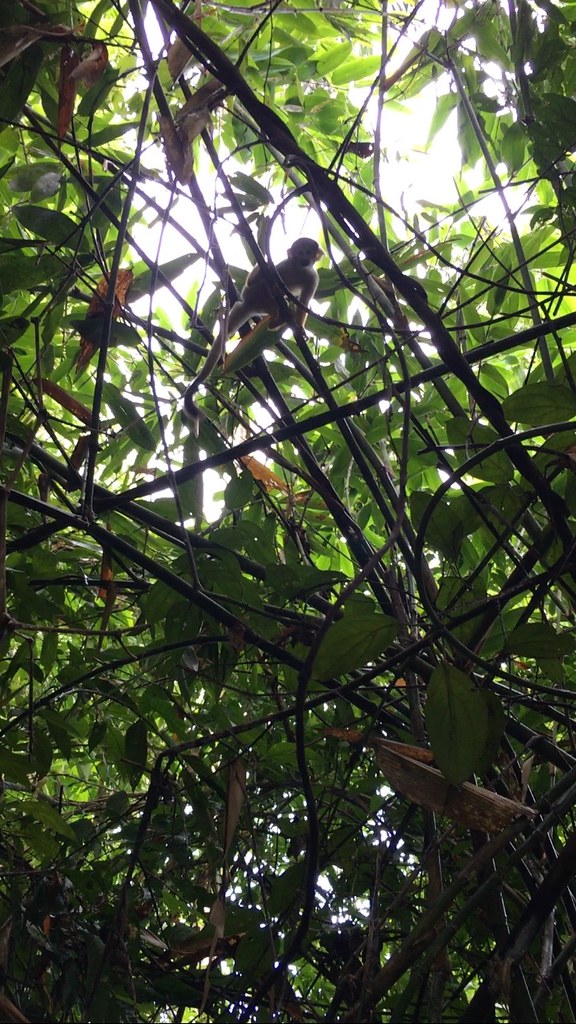
Squirrel Monkey

I also love squirrel monkeys now.  I won’t go on but I want to be one.


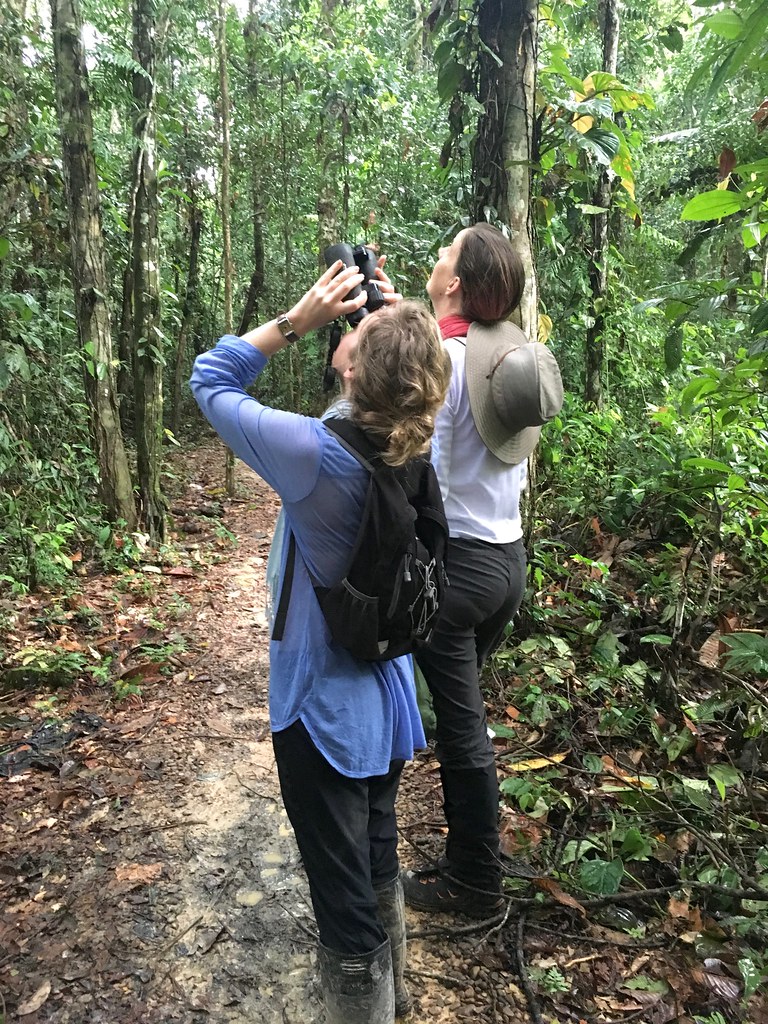
Nina and I looking up at Howler Monkeys


I have dived right in here, there’s so much to write about., a bit about how I came to be here.  The Trélex Amazon Artist Residency was set up in 2014, a conversation happened between Nina (founder of the Trélex Residency in Switzerland) and Kurt Holle (owner of Rainforest Expeditions) and subsequently artists began arriving at the lodges to stay as residents.  Two artists can come at a time during the rainy season, while there are spare rooms available, and so far eleven artists have visited.  A success story but it all happened so quickly.  We went out to talk in person to all the staff, guides, researchers to share our thanks and to highlight why and how much of a difference this opportunity makes to all the artists.


Colin taking about his practice


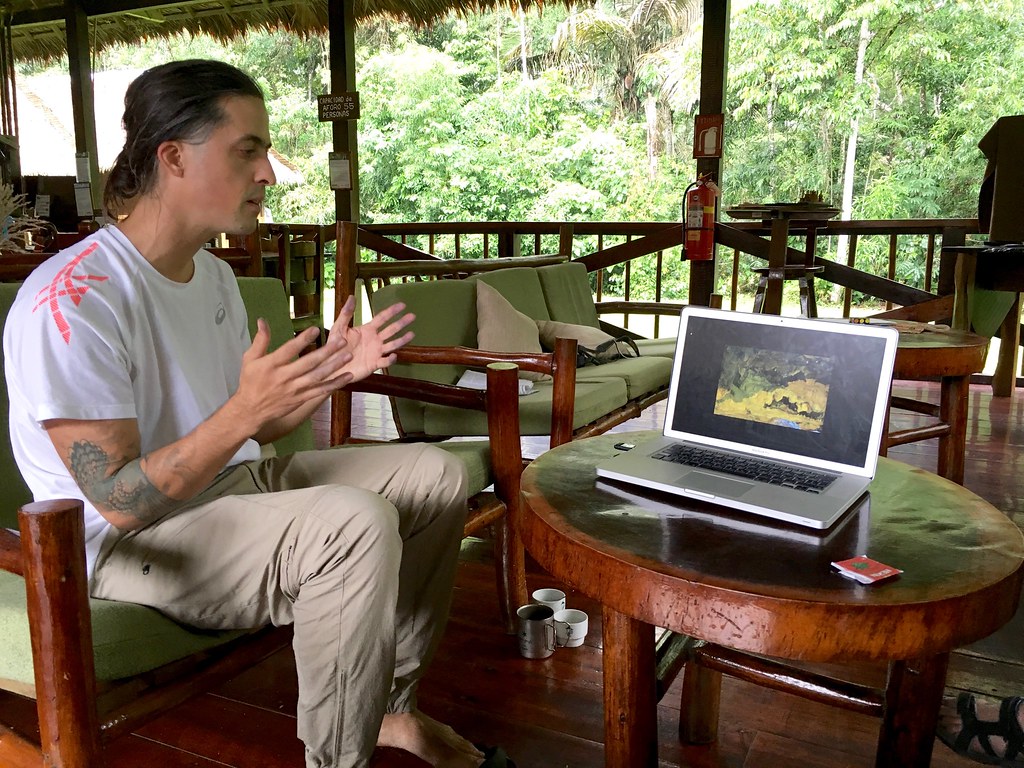
We were also able to spend time with the artists who were residents at the time, Ella, Colin and Maisie.  Over the course of the week we all took it in turns to do a short talk about our our work and our interests.  At Nina’s studio in Trélex, home to the first residency, she usually tries to do this in the first few days of an artist's visit, to kick start a conversation which will most likely continue throughout all the tea and coffee breaks to follow.  I’m always surprised by how much stuff is unearthed when we do this, what ideas and inspirations are making people tick.


Fernando and Nina walking


Halfway through the trip I was taken aback to realise how much of a daily routine we had picked up.  One full of walking and exploring; I don’t think I thought that we would do so much of it.  Each walk we went on was at least a couple of hours and we often went on more than one; I was back in the girl guides.  The trip to the second lodge TRC, involves a six or seven hour boat ride.  Having looked at the area on Google Maps before we set off to Peru, I had a good picture of what we might look like from up above as tiny GPS dots amidst the sea of green.  It was an awesome feeling to know that on each walk we took, the forest surrounding us was never ending.


dramatic atmosphere


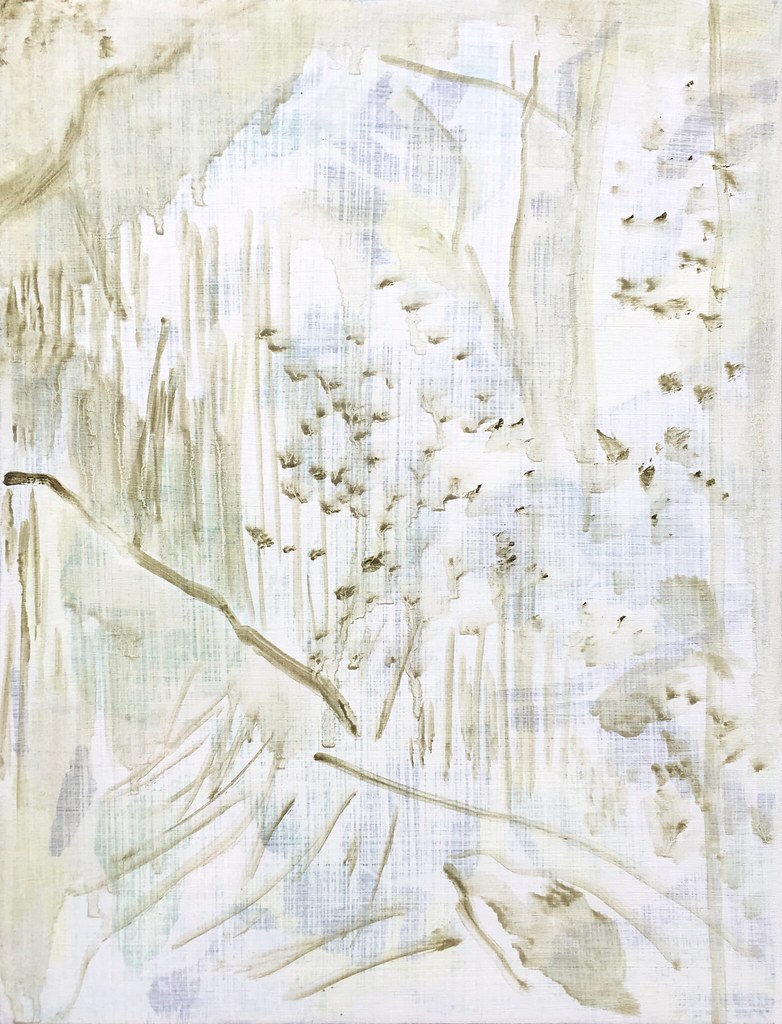
I found a fascination with a lot of things in the rainforest but the thing which kept catching my attention was the way distances appeared.  An interesting sense of depth is created by the humidity, the moisture in the air obscuring anything which lies a short distance away.  Tree filled backdrops are muted and misty creating an incredibly theatrical atmosphere.  Especially in the mornings, along with the howler monkeys eerily sounding off their territory, it often felt like a movie set.


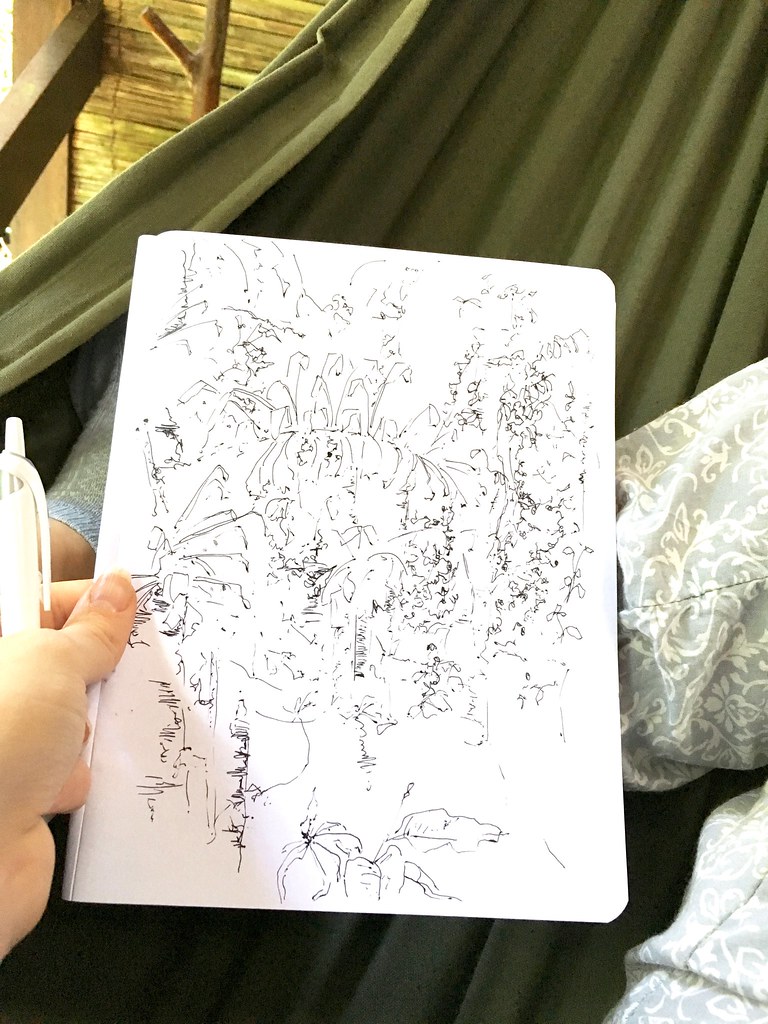
This unusual sense for depth was the thing I felt I could focus on within my work.  My painting has a lot to do with layering and the way things take up space, or not.  I found it difficult to work on anything which would portray all of this during the trip so I stuck to collecting my thoughts, taking photographs and making drawings… visual notes, of everything around me to take back to work on in the studio, back at home in London.


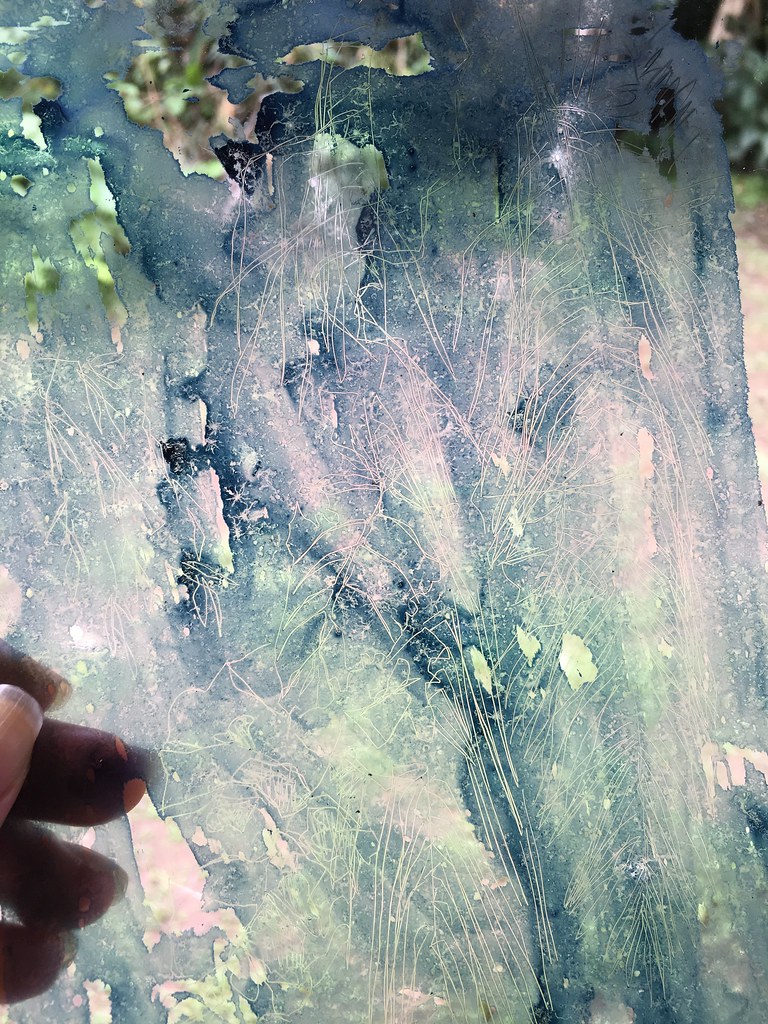
perspex sheet etched into with a nail..

..held up against the rainforest

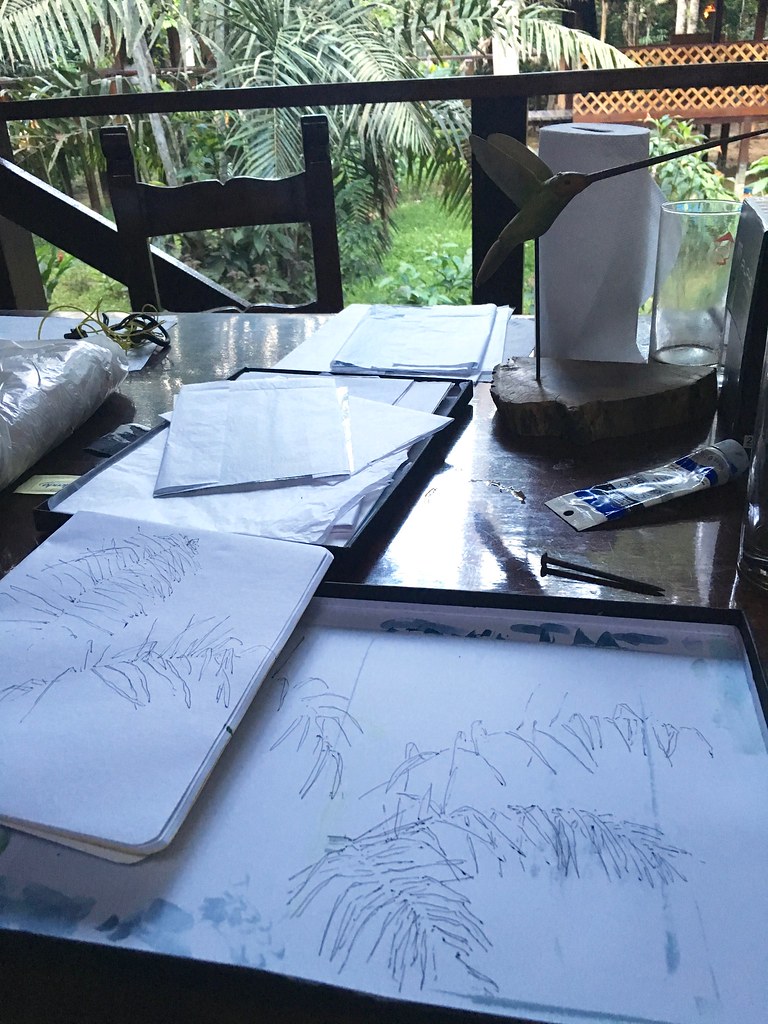
drawing the view from the lodge

Nina and I take over one of the dining tables


On the residency website, Nina has posted a recording that she made on her first visit to Amazonas Refugio.  She posted it as a mild warning to artists for how relentless the rainforest soundtrack is, day and night.  I’ve had it on in the background while I type because I miss it.

Thank you to everyone at Rainforest Expeditions for making this a thing.


abi-box.com
Instagram


Postcard to Fernando (our guide): “To the best pigmy owl impersonator in town. Thank you for taking me and Nina on walks, teaching us what not to touch, how best to cook fish in bamboo and how to milk a Capybara.  I will never forget looking up at the stars!  At Jupiter and the milky way.  I cross my fingers that I am able to return soon and that you can read my handwriting!  Abi xx”


All Lovers Must, Abi Box

An Argument of Branches II, Abi Box

Burnt Spaghetti, Abi Box

Jungle Spatula, Abi Box

Losing Ourselves Together, Abi Box

An Argument of Branches, Abi Box


From Min Kim

27.10 - 18.12.2015

This is extraordinary blog started by Min Kim while at the Trelex Amazon Residency. It is an on-going project as she continues to add to it. When you have experienced it, the rainforest stays with you for a long time.

The blog is called 'Nyctophilia' which means a preference or love for night or darkness. Min Kim's own description of the blog reads: 'infinite night loud eyes picnic ears nocturnal rain blue gaze lemon giggling singing you a long for freedom mother green pivotal moments'

Please visit the blog by clicking here. And remember to subscribe to the blog if you want to read subsequent additions.

And if, like me, you find yourself pulled into the unique poetry of Kim's worldview, I recommend you also look at her post from her time at the original Trelex Residency here.

 by Nina Rodin, Feb 2016.

From Lucie Winterson: afterthoughts...

I came to Madre de Dios on 9 December 2015 and stayed till 8 January 2016   I arrived with the intention of experiencing a new nature.  Nature has always been at the core of my practice and I have many years of familiarity with certain British landscapes: north west Scotland, Devon, and east anglia.   I was, however, thrilled with the idea of turning this over and going to the other side of the globe and to a different terrain — the tropical rainforest, the greatest biodiversity of all.   The most pressing need I had was simply to be in the rainforest.  I wanted to feel it, get to know it, to have time for it to be imprinted on my psyche - and to allow that hoped-for engagement to generate thought and artistic practice.

I didn’t want to predict what I would do but laid out some plans and ideas just in case.   I knew I’d make cyanotypes of plants from the forest.  I’d envisioned this from home with anticipation.  I knew I would take photographs and with any luck work with local earth — and the rest, I would see.    

I had brought prepared cyanotype paper carefully sealed in light fast bags, I’d packed gum arabic to mix with earth so it would adhere to paper, I brought lots of drawing equipment, watercolours and  a good camera.   Along came, also, the good old laptop so as well as writing I could reel through the hundreds of photographs I knew I would take.  Actually it was in the thousands.

I couldn’t help taking photographs whenever I was astonished or amazed by something — which was very often indeed and this constitutes the main body of the work I did there — but I watched out for the point when taking photographs gets in the way of experience, when it becomes acquisitive rather than responsive.   Towards the end I walked in the forest with no camera, note book, or prop of any kind.

Most of my photographs are of looking into the forest at eye level, focusing into the distance to find the sense of the complexity and myriad variety of shape and form, light and shade.   It is different, obviously, from any forest I’ve seen because as well the general vertical tendancy of trees, branches, bromeliads and vines spread horizontally, crisscrossing diagonally and looping in curves.  


 With that and the extraordinary scale and radical shape variation of leaves there is a sense of sculpted space that I found endlessly fascinating and compelling.   Colour wise it is more uniform, the variations in tone coming from the changing light.  Sometimes when the sun is in a particular place and there is a gap in the canopy, light will come beaming down, lighting up just one small area or plant in a sudden incandescence.   And if the changing light wasn’t enough there is also the sudden rains, and the forest is lit up again, differently — leaves glistening and luminous, contrasting with the darkness of the sodden earth and bark.  


I also loved working with cyanotypes of plants from the rainforest, with a sense of experimentation and discovery, my paper running out too quickly.    There is such fine detail obtainable with cyanotypes, even tiny filigree root hairs becoming apparent.   They can also be strongly poetically charged.  The ones I was most pleased with were those where the plant or plants become quite abstract and morphed into a different kind of beings.   When there are two or more plants, it can suggest a dialogue between them but I also enjoyed the bold poetry of a single plant.    Also significant is the way in which the living plant is so directly registered.  It has touched the paper, lain on it, left a resonance, more than a trace.   It was a wonderful way to feel attuned to the forest and is a way of working I will be taking forward in other ways to other places.


I wanted to work with the rain — and this proved quite difficult.  Partly because due to El Niño it didn’t rain as much as usual, and because timing was complex - I wanted to do cyanotypes with rain, but managed only one that I kept.  I needed more paper, more time, more rain!   More satisfactory was mud coated onto paper, and then left in the rain, to register the marks of the rainfall.   However even this was limited.    It would pour, I would prepare the mud on paper which needed to be at a particular point of dampness before exposing it to the rain.  Then I would go out, and of course the rain would have stopped. This happened unaccountably and infuriatingly often.

I also gathered mud to experiment with.  I made small studies of oval shaped mud puddles — reminiscent of eggs or stones.  These dried over a period of several days on the floor of my room and insects crept and hopped out of the mud and over the paper leaving light traces and marks, or in some instances nibbling at the mud and making patterns that way.  I took this all as part of the rhythm and life of the finished sketch.    


On a few occasions I took puddles of paint or mud and left them out over night in the forest, hoping for some action, of insects or rain.   Only one was moderately successful.   The procedure itself was too frustrating in the given working circumstances — and on the whole they were either rained out or they dried too fast for anything to happen.


Later I began to have a lot of satisfaction with drawings of plants made with a pipette using earth from the forest mixed with gum arabic as a binder.    I drew plants I collected from the forest, engaging with them very directly — sometimes only looking at the plant and not even at the paper at all as I followed the form, tracing my seeing.   This helped make as direct connection as I could with the nature of the forest through the process of looking, feeling, drawing.


There was poetry too.  Early on when I’d lost my bearings and was somewhat lonely, my phone threw at me some John Clare poetry.    Phones do this sometimes — when you sit on them or they do ‘bag calls’.  It never feels quite random.   Out of nowhere my phone had got itself into the Kindle app and produced a poem!  It was a minor wonder as the deep communication the poem provided was just what I needed.   I decided I wanted to read John Clare to the rainforest. This early 19th century english poet of nature had suffered chronically due to the loss of the nature he knew, through the enclosures, landowners blocking off access to fields, woods and meadows.  I thought I’d take him through space and time to a different hemisphere via his poetry to an encounter with a tropical nature of now.  I found a way to do this and film it, in a watery area of forest.

And now I’m back but it still feels very recent.   Just three weeks ago I was there and it will take a while to process it all.  Having made a personal connection to this extraordinary place, I’m wondering how to apply this more widely.  I’m also thinking further of contexts including that of climate change, the impact of damage and loss.  I’m not there yet, but I’m beginning to shape the exhibition I intend to have and thinking of what else I will be doing going forward. 

My feeling is that encounters with all variety of nature in this increasingly globalised world whose biosphere is in crisis, are radical and precious and that the creative language which emerges, in whatever art form, needs to be spoken out loudly.

(written 01.02.2016)

From Lucie Winterson

09.12.2015 - 08.01.2016


Into the rainforest


The heart of darkness, the great unfurling of deep nature, the ferocious jungle, the unrepressed.    I came with these preconceptions and observed with curiosity as they fell away, waiting to find out what would replace them.  The jungle myths were easily dispelled.  The forest is far more than the site of grim battles to the death, it is not rife with danger.   Those things are a small part of what it contains but mostly the jungle is calm, with noises rising and subsiding.  

Visually it is endlessly interesting because the vegetation is so varied and the real exotic — wonder at the ‘different’ — is pleasurably here.   Trees whose roots start outside of the ground, ‘walking’ trees, trees with buttress roots.    A tree that smells strongly of garlic after the rain.    The two things that most astonished me when I first entered the jungle, were both sounds.   One a bird, the ora pendula, whose call sounds like a pebble being dropped into water with a loud ‘plop’ and the other was the howler monkeys — which don’t howl at all.  They emit a sound like a low but rising wind that spreads through the forest as if from very far away.    The most apparent thing that moves is the light and the changing weather.   Over all the forest is peaceful.


The danger myth is the hardest one to shake off.  I learned last night what to do if I encounter a jaguar.  Don’t run or you become prey.   Make bizarre and unlikely noises to frighten it off.   I was also told that unlike jaguars, pumas will stalk you.  But they are more in the higher areas and the mountains, not here.  In which case why were several of them very evident in the footage from the camera traps presented here the other night?   They are here in fact, very much so, all of them, walking the same paths as us.    But they slip away, dissolving into the jungle at the hint of a human.   As hard as I try, though, I can’t feel fully confident that I won’t get eaten by a jaguar, ocelot or puma.    To ask for a foolproof guarantee is unreasonable, I know, but I can’t help trying.  The best answer I get, really, is that it has never happened.   Well, to anyone with the remotest tendency to paranoia how does that help?  

Initially I take off into the forest and the wonder of it will sweep me up — as I walk it passes rapidly through different phases of light, of rain, of luminous density and intricate shadow.  After some walking, however, when I’m sweating and damp, tired and perhaps with minor sunstroke, my camera has steamed up and I’m a fair way from the lodge; then the jaguar thoughts will come.  The pumas of the mind will stalk me:   ‘It’s never happened…….But it could’.     The forest turns muddy and loses its gleam. I hasten back.

So far there has been only one mote of darkness.   Falling asleep one night I heard a creature I’ve never heard before or since.  A bird? A frog?  Its sound was eerie and mocking.  A malign little goblin laugh feeding into my dreams.

Madre de Dios, Peru Christmas day 2015


From Colin Miner

2 Jan - 30 Mar 2016


The man, who day after day, took pictures of shadows   

A while ago that still feels recent, I learned to walk with a cat. We followed many paths, like methodologies, which often offered long waits for things that would not appear.   

Alongside, my eyes began looking for birds, an occupation that came naturally. Colour, form, movement, and specific qualities of relations proposed comparisons to be translated through depictions in books.   

Familiar with looking for details in contrast to positions of movement, my eyes became disciplined on stillness.   


Having trained them to see birds, my eyes turned curious for cats. And so, walking with one cat lead to a lot of walking looking for cats. Previously there appeared not to be many cats and now, many many cats. 


Along with a cat (Ocelot) I had the wonderful experience of sharing space with a sloth, harpy eagle, and countless other living organisms during my residency. It was an experience that has taken a significant amount of time to process and was immensely generative in affecting my practice and offering points of departure that I am still exploring. One of the most beneficial aspects was the prolonged period of reflection and contemplation that was offered. It is rare to be offered such an open-ended opportunity in addition to support for a sustained engagement. At first overwhelmed by the heat, humidity, extreme diversity and density of the ecosystem I became able to sink into the uniqueness of a space and time of the remote amazon rainforest. The adaptation that assisted me the most was a developing of slowness – or slowing down, in which to be as present (and reflective) as possible. Experiences with cats, birds, and the complexity of that ecosystem have lead to the development of works exhibited over the last few years in numerous institutions within Canada, and a forthcoming publication with Blank Cheque Press (late 2018-early 2019).  Further research influenced by this residency is being conducted on the subject of the sloth and slowness in relation to contemporary art theory and a concept of anxiety as question without answer. 

Further information on projects and work influenced by this residency can be found at www.colinminer.com


I would like to offer my sincere appreciation for all the support I received leading up to, during, and following my residency with Trelex in the Peruvian Amazon. There were so many wonderful experiences and challenges that have affected both how I experience and understand the world in which I reside. That is a remarkable thing to be offered at any stage in life and would not be possible without the generosity of the people, place, and all the amazing inhabitants (lanes, insects and animals) of the Tambopata region. 


Link to Untitled (leaf) here